Attila the Hun
-
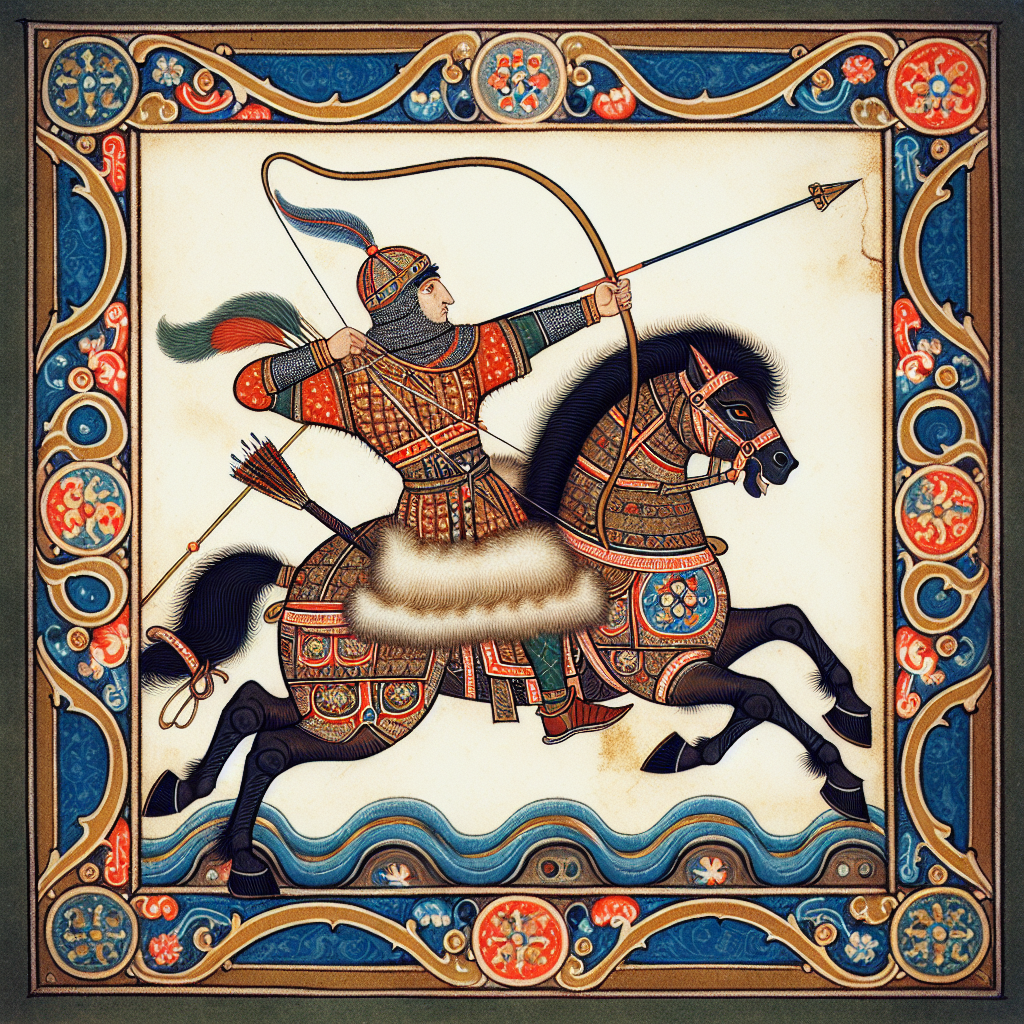
Let's kick off this long weekend with #EuropeanBios entry #17, Attila, usually called "Attila the Hun". He's your typical world-conquering general in the vein of Alexander, Hannibal, Caesar and Napoleon, but what we don't know about him is honestly probably more interesting.
-
By "typical world-conquering general", I mean: new technology was invented, he mastered it before others, he conquered the world with it, he over-reached, he died young, he failed to have a succession plan, and his empire collapsed afterward. This is a surprisingly common story!
-
Like I said, there's a lot we don't know about him. That's because his people, while not illiterate, did not bother to write down their history. So all histories of Attila have been written by people he conquered, who understandably hated him and didn't know him well anyway.
-
Start at the most basic: like Plato and other ancients, the name we call him is not his name. "Attila" means "little father" and was probably a sort of affectionate nickname, like "great leader", like "Atatürk" means "Father of the Turks". We don't know if he used any other name.
-
This linguistic connection to Turkish is possibly not coincidental, but brings us to the other big thing we don't know: where he was from. We're not at all sure where the Huns came from in the first place, except that it was "from the east", somewhere in the middle of Asia.
-
The best guess at the moment is that a bunch of people from the north-eastern Steppes of Europe slowly migrated east, settled in Mongolia, and started harassing China for a number of centuries. Their original western origin is a mystery, though there are some connections to Iran.
-
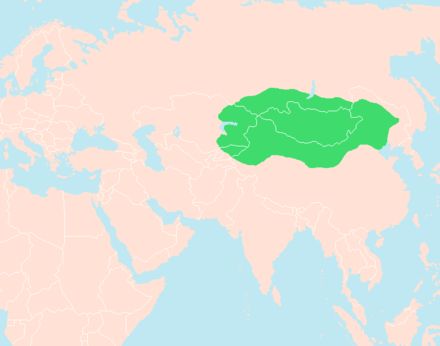
The probable origin point of Attila's Huns, although his ancestors may have migrated there from much further west. Photo by Postmann Michael via Wikimedia Commons (public domain) -
Regardless of original origin, the Huns hung out in Mongolia for centuries and made a real nuisance of themselves. The chinese empire bought them off, including providing high-born women as wives for Hun leaders, leading to an uneasy peace.
-
This brings us to the next thing we don't know: what he looked like. There's no pictures of him by anyone who saw him, and descriptions of him in text are mostly about how ferocious he looked. Some descriptions of him make him sound Turkish or Iranian looking, others like a Mongolian.
-
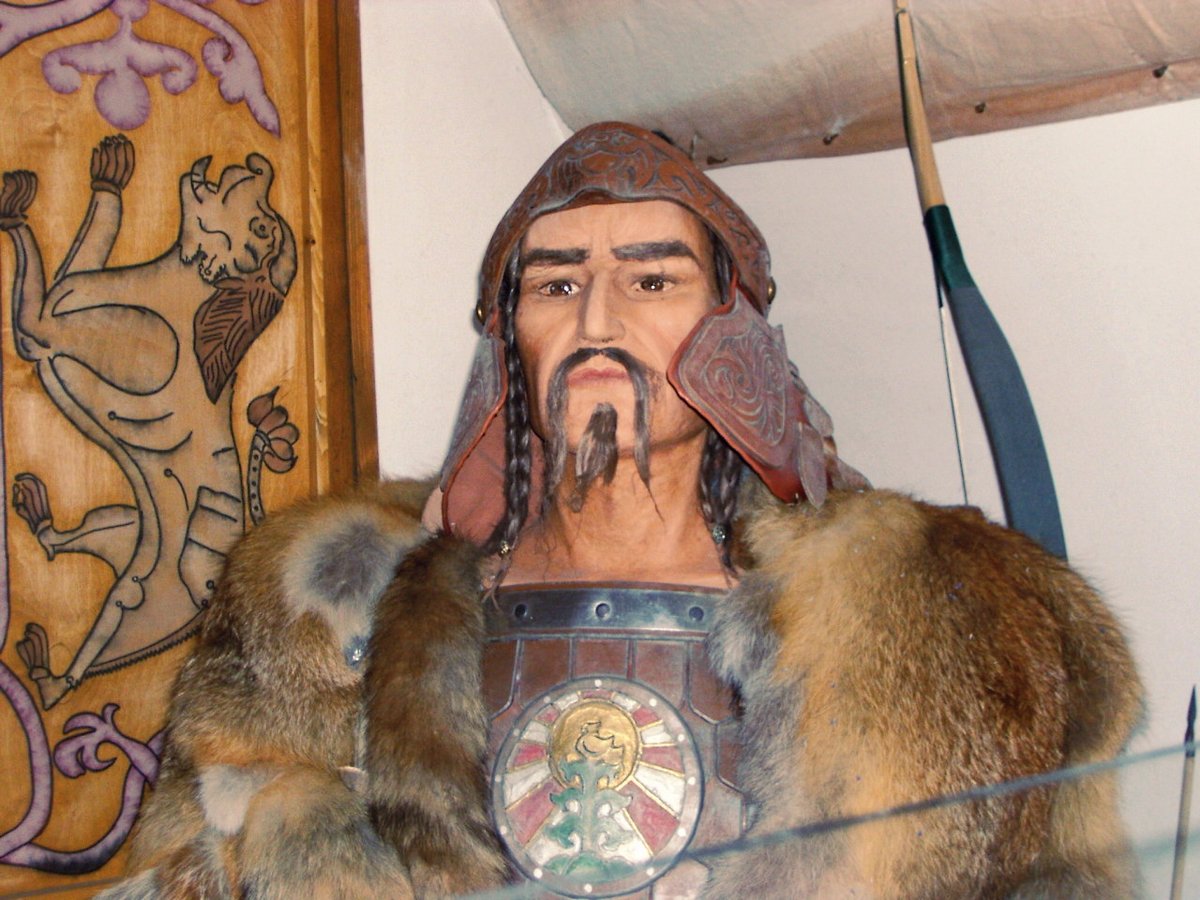
A not-particularly-well-made rendering of what Attila might have looked like, from a Hungarian museum. CC BY-SA A.Berger via Wikimedia Commons -
Given that for centuries a bunch of people from maybe Iran had been camped out in Mongolia marrying their leaders to women from China, this may be spot on: he may have been an ethnic mix of some kind. The only other thing we know about his appearance is that he was short.
-
Attila was born around 406AD. To place this relative to our other recent subjects, this is 10 years after Theodosius died, and 25 years before Augustine of Hippo did. So while Augustine was writing his final confessions, Attila was just about to fuck with Europe.
-
A thing I didn't realize until reading Attila's bio is that the nation of "Hungary" is named after the Huns because they settled there for a while. Hungarian culture and history love Attila and claim direct descendence from him but the historical evidence for this is slim.
-
"Hun" by the way is not the name they called themselves. While they were hanging out in Mongolia attacking China they were known as the Xiongnu; in Mongolian the local words for the Xiongnu and the Huns sound similar. Europeans called them Huns.
-
Sometime around 100BC the Chinese got their shit together and drove the Xiongnu out of Mongolia, ending their lives as a bunch of (relatively) peaceful nomads with semi-fixed seasonal habits to more like a wandering band of bandits. This kicked off centuries of turmoil.
-
Long before Attila was born, the Huns left Mongolia and headed west. They bumped into other tribes, who fled west, bumping into other tribes further west, creating a sort of train of heavily-armed refugees who arrived in Europe, looking for space to live, pillaging as they went.
-
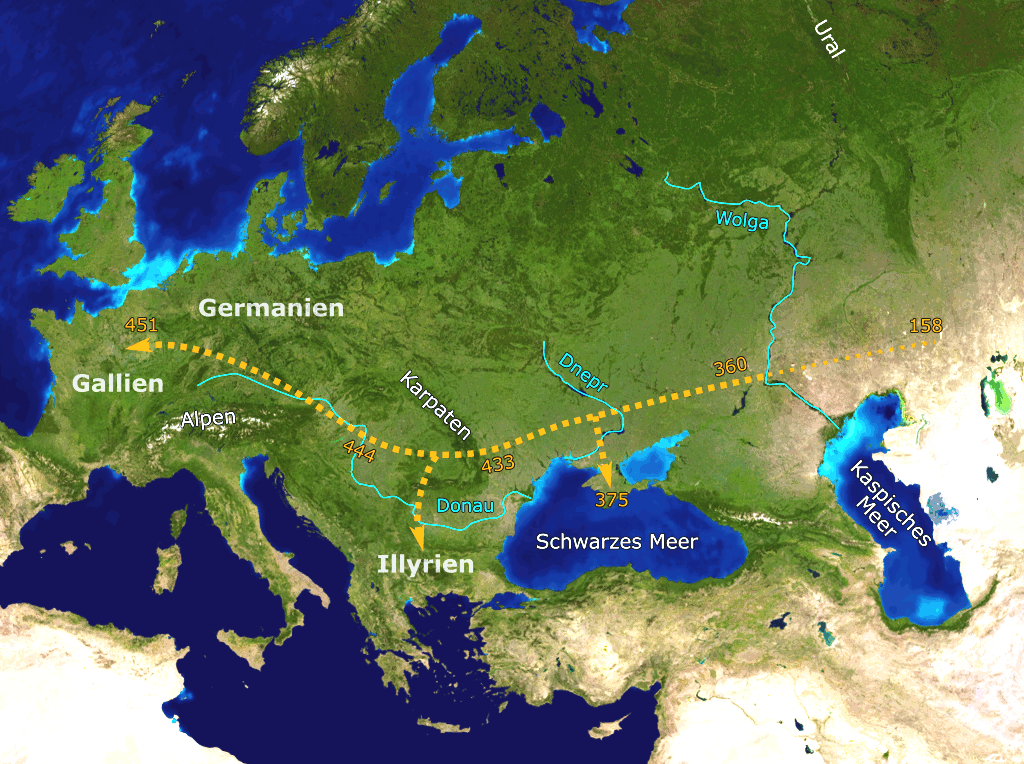
The migration path of the Huns, with roughly the year they were there. CC BY-SA by Stw via Wikimedia Commons -
This manifested to the confused and terrified Europeans as centuries of invasion by foreigners from the east, the "Barbarians", a word which at the time simply meant "foreigner", and only acquired negative connotations at this time as a result of all this pillaging.
-
Eventually around 375AD the Huns themselves showed up, led by Attila's father. This is another thing Attila has in common with the big world-conquerors: like Alexander and Hannibal, he was a son of an already very powerful general and inherited control of an existing army.
-
The reason Attila and the Huns for centuries before him had been able to drive whole populations to migrate was because they were absolutely devastating in battle. Attila's biographer goes off on a long tangent about their weaponry because their battles were so lopsided.
-
First: they built bows and arrows better than anyone else. Not slightly better. Their bows took a year to make and could fire arrows further and faster (200kph!) than anybody else at the time. Not until composite carbon bows in the 20th century did anybody get close to them.
-
Second: they were able to fire accurately from horseback. Not only were they better than anybody at this, they were better at this than anybody's ever been. Modern attempts to replicate their technique have failed until quite recently. In particular, they could fire backwards.
-
"Firing backwards" doesn't really seem like it should be such a big deal but it meant that uniquely of all military units at the time they could retreat while still killing their enemy. So they could advance, kill people, fall back, kill more people, repeat until victory.
-
Third: they could fire way, way faster than anybody else. Attila's biographer estimates 2000 Huns could manage to fire about 12,000 arrows in the course of 60 seconds. This is a fire rate equivalent to 5 machine guns, except machine guns that are riding towards you and screaming.
-
So Attila and his devastatingly effective army then went on a tour of Europe. The details are mostly dull. They threatened Constantinople (the "Eastern" Roman empire), who were extremely rich and bought them off. They took this money and settled for a while, building a palace.
-
A "fun" fact about Attila's palace is that it had Roman-style baths built by a Roman architect he'd taken hostage. The hostage had hoped in return for the baths he'd be set free, but instead Attila made him the bath attendant.
-
Around 450 Attila decided to take the "Western" Roman empire. This was the "over-reach" stage of the world-conquering general's life. This was kicked off by the sister of the emperor at the time, Honoria, who had been promised in marriage to a senator she didn't like very much.
-
Honoria, seeking escape, sent her ring and an offer of marriage to Attila, promising he could become emperor. This was disputed by everyone, not least her brother the emperor. But Attila, probably intending to attack anyway, either took her seriously or pretended to.
-
It didn't go well! He took huge chunks of Europe but eventually the Romans allied with the Goths (i.e. all the other people the Huns had pushed west earlier) and everybody banded together and beat the shit out of the Huns near Orleans in modern-day France.
-
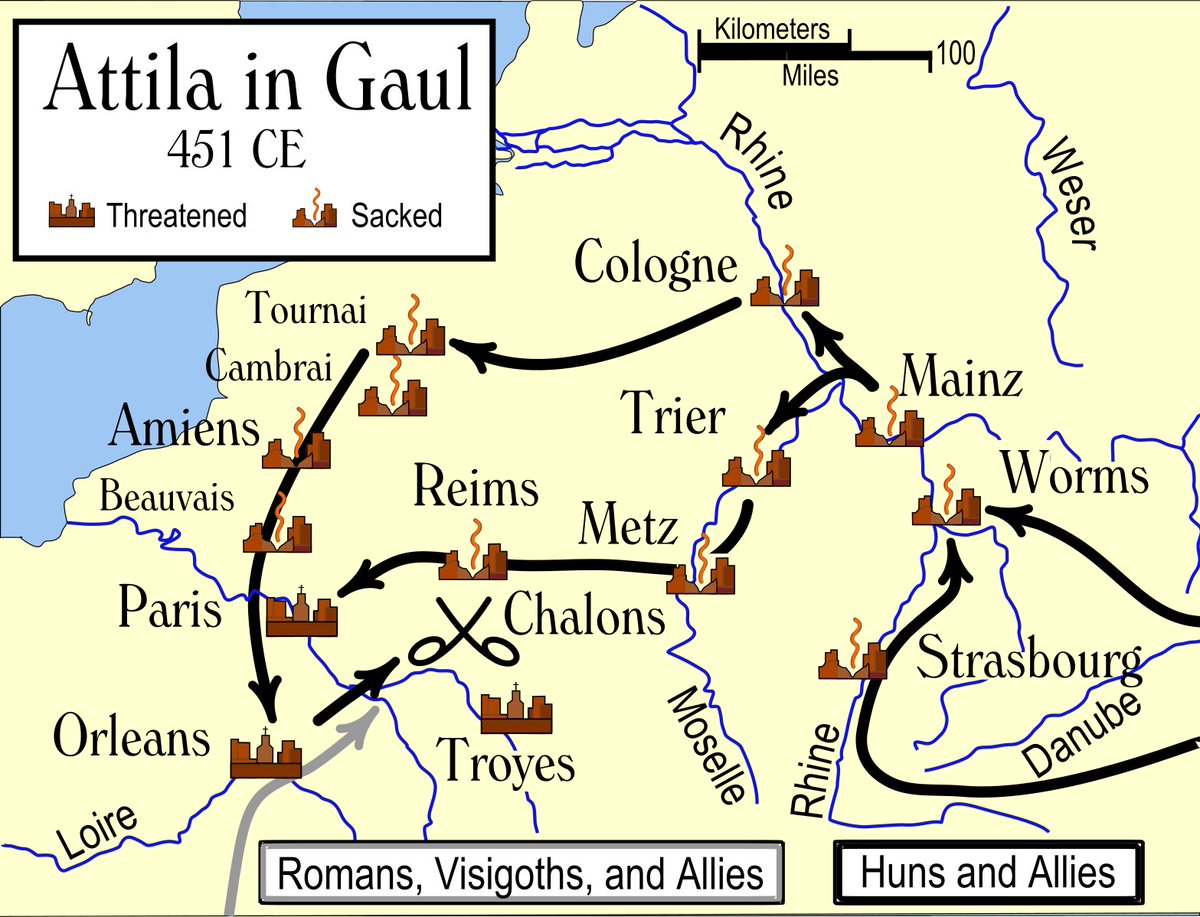
A map of Attila's final rampage and eventual defeat at Chalons. CC BY-SA by MapMaster via Wikimedia Commons -
Attila survived the battle and went back to his palace to plan revenge. He married a lady called Ildico, got extremely drunk, suffered some kind of throat hemorrhage (perhaps caused by long-term alcoholism), and drowned in his own blood at the age of 47. She was accused of murder.
-
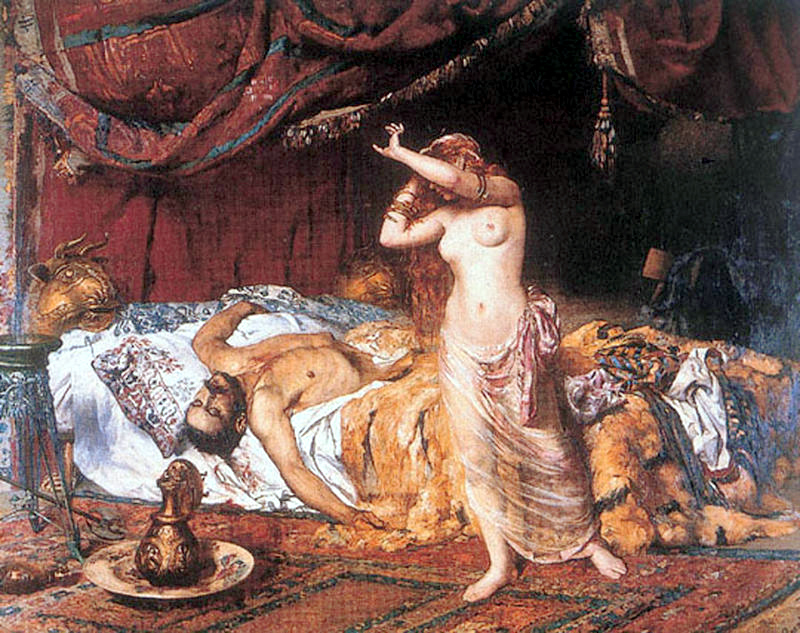
You too would be distraught if you married the ruler of a huge chunk of the world and he kicked it on your wedding night. Public domain painting by Ferenc Paczka -
And then of course it all immediately went to shit. He had many children and they fought over bits of his empire. The Roman empire, already collapsing when Attila got there, continued to collapse and was overrun by various Goths and other non-Roman folks.
-
Attila was doubtless an amazing leader and a fearsome warrior, but also in the right place at the right time, when technology and location combined with the opportunity of a weakened Rome to dramatically sweep across the continent. Like Alexander, he just didn't know how to stop.
- Previously: Augustine of Hippo
- Next: Justinian the Great
- Full list
Text and images copyright © 2020-2023 Laurie Voss
except where indicated
except where indicated